
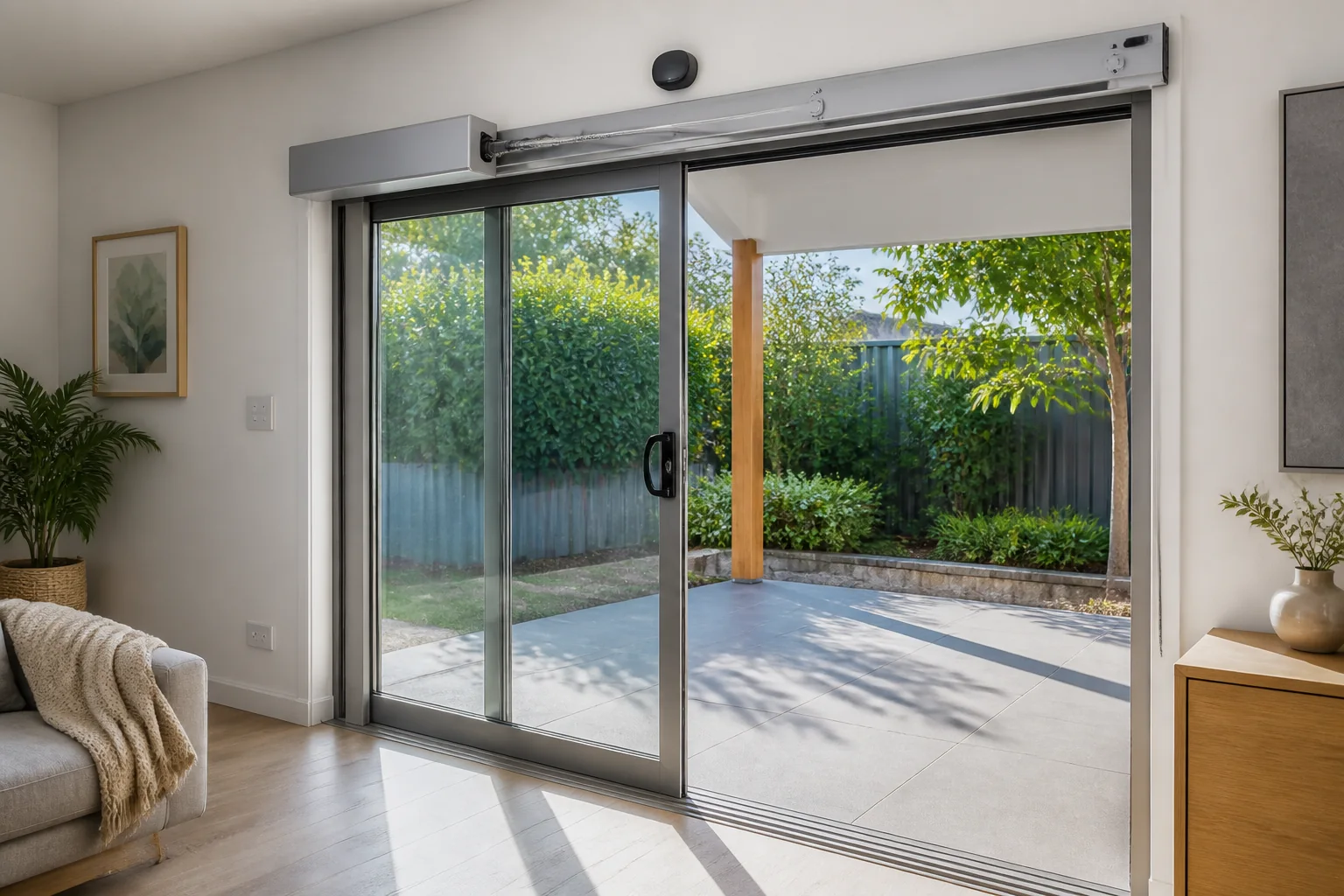
Autoslide commonly refers to a retrofit operator that motorises an existing sliding door using a powered drive, controls and optional sensors. For an Australian project, do not select it from door width alone. Check the existing panel’s drag, opening travel, track condition, mounting support, power route, activation method, safety sensors, locking, weather seals, user needs and applicable building requirements.
Key takeaways
- A retrofit operator moves the door; it does not correct a damaged, poorly supported or high-friction sliding panel.
- Measure operating force and clear opening as well as panel size and weight.
- Coordinate sensors, controls, locks, manual release, power and pinch-point protection as one system.
- Residential convenience equipment should not be assumed suitable for a public or required-access doorway.
- Confirm the exact current model, instructions, warranty and installation method with the manufacturer or authorised supplier.
What is an Autoslide automatic door system?
In this article, Autoslide is the third-party brand named in the search phrase. Its published technical sheet describes a rack-and-pinion operator intended to retrofit suitable sliding doors, with an operator, power supply and remote controls or sensors. Forge has no stated affiliation or endorsement, and this guide does not confirm that a particular Autoslide model is compatible with a Forge door.
The linked Autoslide technical data sheet is marked as last updated 7 January 2021. It lists model-specific values including a 600 mm/s rated opening speed, 300 mm/s rated closing speed, 97 N maximum opening force, 920 mm maximum opening width and 30 W motor. Treat those figures as document data to verify against the current product being offered—not as a specification for every Autoslide variant.
Check the existing sliding door before choosing an operator
- Identify the door construction. Record frame material, panel arrangement, sliding direction, glass, handle, lock and the available head or floor mounting zone.
- Service the manual door first. The panel should run smoothly on sound rollers and a clean, aligned track without scraping, binding or uncontrolled movement.
- Measure operating force. Test drag through the full travel, not only the initial pull. Weather seals, brushes, track debris and alignment can change the load.
- Measure travel and clear opening. Confirm the required human passage and the space available for the drive rack, operator and stops.
- Check structural fixing points. The surrounding substrate must support the proposed fasteners and loads without fixing into glass, drainage paths or unsuitable trims.
- Plan power and cables. Identify the outlet, low-voltage cable route, isolation and protection from damage or water.
- Review the doorway’s role. A home patio opening, an accessible entrance, a fire or smoke door and a commercial public entrance can have different requirements.
The technical sheet says the operator is not intended to support the sliding door; suitable rails and guides must already be fitted. That distinction is important. Automation should follow mechanical rectification, not conceal a failing track or roller system.
Coordinate sensors, controls, safety and locking
| Element | Questions to resolve | Typical failure if overlooked |
|---|---|---|
| Activation | Push button, remote, presence sensor, pet tag or smart-home command? | Unwanted openings or an inaccessible control |
| Presence safety | How are people, children, pets and objects detected in the travel path? | Impact, trapping or repeated reversals |
| Closing edges | Where are shear and pinch points, including the interlock and jamb? | Unsafe hand or finger access |
| Locking | Does the existing lock remain usable and how does any electronic lock fail? | Door attempts to move while locked or cannot secure |
| Manual operation | How is the door opened during power loss, fault or emergency? | Occupants cannot use the opening as expected |
| Weather sealing | Does motor control preserve full closure without excessive force? | Air or water leakage and premature wear |
Autoslide’s current Australian shop and support site presents single-sliding, multi-sliding, accessibility, pet-access and security-related options, along with manuals, installation videos and dealer information. The presence of an accessory in a catalogue does not establish that it is required or sufficient for a particular opening. Use the exact current manual and a competent installer’s assessment.
Consider Australian project requirements
Motorising a door can change operating forces, controls, locking and how users interact with the opening. Where the door forms part of a required accessible path, entrance, escape route, fire or smoke separation, or public commercial tenancy, obtain advice from the responsible building, access, fire and electrical professionals before selecting equipment.
For external glazed doors, the original assembly also has structural, water, air, glass and installation functions. Review the Australian Building Codes Board’s NCC Housing Provisions glazing scope where relevant, together with current jurisdictional provisions. Adding an operator does not create evidence for the underlying door.
Compare retrofit automation with other approaches
| Approach | Best suited to | Main limitation |
|---|---|---|
| Retrofit residential operator | A compatible, free-running existing door where convenience is the goal | Fit, force, sensor and doorway-role limits must be checked |
| New integrated residential system | Projects where door and automation can be coordinated from design stage | Higher replacement scope and project lead time |
| Commercial automatic entrance | Public or higher-duty access designed as a complete automatic door | Specialist design, installation, compliance and maintenance |
| Manual hardware upgrade | Reducing friction or improving usability without automation | Does not provide powered opening |
Read the automatic door systems guide for a broader specification workflow. If the existing door itself needs replacement, review the Forge sliding door range and coordinate the new frame, sill, hardware and automation before ordering.
Installation, commissioning and handover checklist
- Record the operator model, serial number, firmware or settings version where applicable.
- Verify door travel, opening and closing speeds, forces, hold-open time and end positions using the current instructions.
- Test every activation device and safety sensor from realistic approach paths.
- Test obstruction response, manual release, power interruption and return to service.
- Confirm locking logic and prevent operation against a manually engaged lock.
- Inspect clearances, cables, covers, fasteners, drainage and weather seals.
- Give occupants operating, cleaning, inspection and fault-response instructions.
- Set a maintenance interval suited to duty, environment and manufacturer requirements.
Do not leave commissioning assumptions undocumented. A simple handover record makes later changes to sensors, locks or door hardware easier to assess.
Ask Forge about the underlying door system
If you are planning a new or replacement sliding door that may be automated, send the project location, building and doorway use, opening size, drawings, panel weight if known, required clear opening, glass and performance targets, control concept and programme through the Forge contact page. Forge must confirm what door configurations and coordination information are available; a specialist automation supplier may also be required.
Sources and evidence boundary
This independent guide references third-party product information because Autoslide is the target keyword. Product specifications, model names, prices, availability and manuals can change. Verify the exact current product and installation instructions with Autoslide or an authorised supplier. Nothing here certifies compatibility, accessibility, safety or regulatory compliance for a specific doorway.
Frequently asked questions
Can Autoslide fit every sliding glass door?
No. Compatibility depends on door condition, drag, travel, weight, opening width, frame and mounting geometry, locks, power, controls and the doorway’s use. Check the exact operator instructions and have the complete opening assessed.
Should I repair the door before adding an automatic opener?
Yes. The panel should be free-running on sound rollers, track and guides before automation. An operator is not a substitute for repairing damaged hardware, alignment, structural support, drainage or seals.
Does an automatic sliding door still work manually?
That depends on the product, mode and installation. Confirm manual operation and release procedures for normal use, power loss and faults, then test them during commissioning and explain them at handover.
Are safety sensors always required?
Sensor needs depend on the operator, settings, users, doorway role and applicable requirements. Do not assume a basic activation button provides presence protection. Follow the current manufacturer instructions and project professional advice.
Can Autoslide be used for a shop entrance?
Do not assume a residential retrofit operator is suitable for a public or commercial entrance. Duty, safety, accessibility, egress, fire, maintenance and liability requirements may call for a purpose-designed commercial automatic door system.