
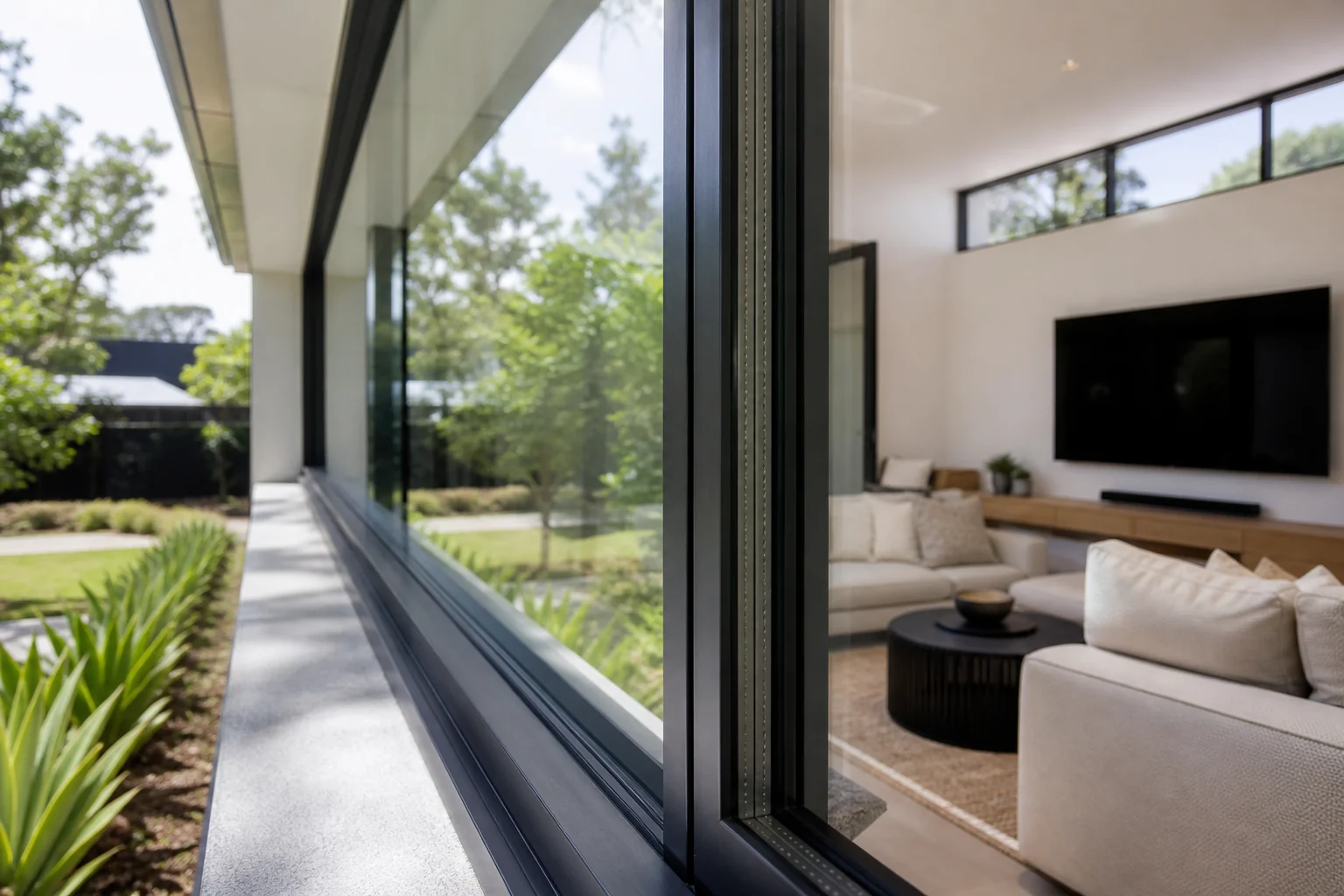
Low-E glass and double glazing solve different parts of the same problem. Low-emissivity (Low-E) glass uses a thin coating to manage radiant heat transfer, while double glazing uses two panes separated by a sealed gap to reduce heat flow through the glazing unit. For many Australian projects, the best-performing answer is not one versus the other, but Low-E glass inside a well-specified double-glazed, whole-window system.
Key takeaways
- Low-E is a coating technology; double glazing is a two-pane construction.
- Compare whole-window U-value and SHGC, not marketing names alone.
- Climate, orientation and shading determine whether solar gain should be encouraged or limited.
- The frame, seals, spacer and installation can change the result as much as the glass choice.
- Use project modelling and product-specific data before ordering.
Low-E glass vs double glazing: the definitions
Low-E glass is glass with a microscopically thin, low-emissivity coating designed to reduce radiant heat transfer. Depending on the coating and its position, it can improve U-value, SHGC or both. The coating may be used on a single pane, but it is often protected within an insulated glass unit.
Double glazing, also called an insulated glass unit (IGU), consists of two panes separated by a sealed air or gas-filled gap. The gap limits heat transfer compared with a single pane. The Australian Government explains that double glazing commonly uses air, argon or krypton in the cavity and reports that it can reduce heat loss by up to 30%; the actual whole-home result depends on the selected window, area, climate, building fabric and installation.
Low-E glass and double glazing compared
| Decision factor | Low-E glass | Double glazing | Combined system |
|---|---|---|---|
| Primary mechanism | Coating manages radiant heat transfer | Sealed cavity reduces conductive and convective heat flow | Addresses multiple heat-transfer paths |
| Key rating effects | Can change U-value, SHGC and visible light transmission | Usually improves U-value over single glazing | Can be tuned for climate and orientation |
| Solar control | Coating selection can reduce unwanted solar gain | Clear double glazing alone may still admit substantial solar radiation | Low-E coating can add targeted solar control |
| Winter heat retention | Can reduce radiant loss | Sealed gap reduces heat transfer | Often the stronger option where low Uw is required |
| Noise | Not automatically an acoustic solution | Can help with some frequencies; glass thickness and cavity design matter | May still require laminated or asymmetric panes |
| Verification | Compare the exact whole-window Uw and SHGCw for the complete product | ||
The Australian Government’s Your Home guide notes that Low-E coatings can significantly improve both U-value and SHGC, but must be selected and used correctly. It also stresses that whole-window performance depends on both glass and frame. This is particularly relevant to aluminium: an unbroken aluminium profile conducts heat readily, while a thermally broken profile separates the inside and outside aluminium sections with a structural insulator.
Which option suits Australian climates?
Hot and cooling-dominated locations
In northern and strongly cooling-dominated climates, limiting unwanted solar gain is often a major priority. A Low-E or solar-control coating with an appropriate lower SHGC can be valuable, particularly on east- and west-facing glazing that receives difficult low-angle sun. External shading should be designed with the glass rather than treated as an afterthought.
Temperate and mixed climates
Sydney, Perth and Adelaide projects often need to balance summer cooling with useful winter solar access. A single glass specification on every elevation may not be optimal. Correctly shaded north-facing windows can admit winter sun, while east- and west-facing openings may need stronger solar control.
Cool and heating-dominated locations
In Canberra, Hobart, Melbourne and other cool locations, reducing heat loss through a lower whole-window U-value often carries greater weight. Double glazing, Low-E coatings, warm-edge details, effective seals and a thermally improved frame can work as one system. The Australian Government windows guide states that double glazing is usually sufficient for Australian energy efficiency and comfort, while triple glazing is more relevant to extremely cold climates.
Five questions that lead to a better choice
- What does the energy report require? Record whole-window Uw and SHGCw targets rather than “double glazed” as a complete specification.
- Which way does each opening face? The coating that works on a shaded north elevation may be wrong for unshaded west glass.
- Is winter solar gain useful? A very low SHGC can reduce helpful winter sun as well as harmful summer gain.
- What does the frame contribute? Pairing high-performance glass with a highly conductive frame may leave a weak thermal path and a colder internal frame surface.
- Are there acoustic, safety or bushfire requirements? These may change glass thickness, lamination, toughening or screen details. Thermal performance alone cannot resolve them.
A practical glazing specification checklist
- Window and door schedule reference, dimensions and opening type
- Whole-window U-value (Uw) and SHGC (SHGCw)
- Glass build-up, including pane thicknesses and cavity width
- Low-E coating type and coated surface position
- Gas fill and spacer specification where applicable
- Frame series and whether the aluminium profile is thermally broken
- Visible light transmission where daylight and colour appearance matter
- Safety-glazing, acoustic, wind, water and bushfire requirements
- Product-specific WERS or AFRC-recognised evidence
- Installation, perimeter sealing and flashing requirements
Forge’s aluminium window range includes systems compatible with double glazing and Low-E insulated glass. Compatibility is only the starting point: request the exact performance evidence for the proposed frame, sash and glass configuration. Explore the aluminium windows and doors range and use the project’s energy documentation to frame the enquiry.
Common specification mistakes
- Using “Low-E” as if it describes one universal coating.
- Assuming all double glazing has the same cavity, spacer, gas fill or performance.
- Comparing glass-centre values with whole-window values.
- Choosing by climate zone but ignoring elevation and shading.
- Expecting thermal glass alone to solve low-frequency traffic or aircraft noise.
- Making a product substitution without rerunning the energy model or checking the allowable value range.
Frequently asked questions
Is Low-E glass better than double glazing?
Neither is universally “better” because they are different technologies. Low-E is a coating that manages radiant heat transfer; double glazing is a two-pane sealed unit that reduces heat flow. The stronger solution is often a Low-E double-glazed system selected by whole-window Uw and SHGCw.
Can double glazing include Low-E glass?
Yes. A Low-E pane can form part of an insulated glass unit, with the coating positioned on a protected surface appropriate to the required performance. The exact coating, cavity, spacer, frame and orientation determine the whole-window result, so check product-specific data.
Does double glazing stop noise?
Double glazing can reduce some medium- to high-frequency noise, but it is not automatically the best acoustic specification. Traffic and aircraft noise may require different pane thicknesses, laminated glass, a suitable cavity and excellent seals. Obtain an acoustic design where noise is a key project criterion.
Should every window in a house use the same Low-E glass?
Not necessarily. Different orientations receive different amounts and angles of sun. Energy modelling may support a higher SHGC on correctly shaded north-facing glass and lower SHGC on exposed east or west elevations. Visual colour consistency should also be reviewed before mixing glass types.
Choose a whole-window solution
The useful question is not simply “Low-E glass or double glazing?” It is: which complete window produces the required U-value, SHGC, daylight, comfort, safety and acoustic result for this opening? Coordinate glass, frame, seals, shading and installation, then retain the rating evidence with the specification. For a project-specific discussion, contact Forge Windows with the window schedule, location, drawings and energy targets.