
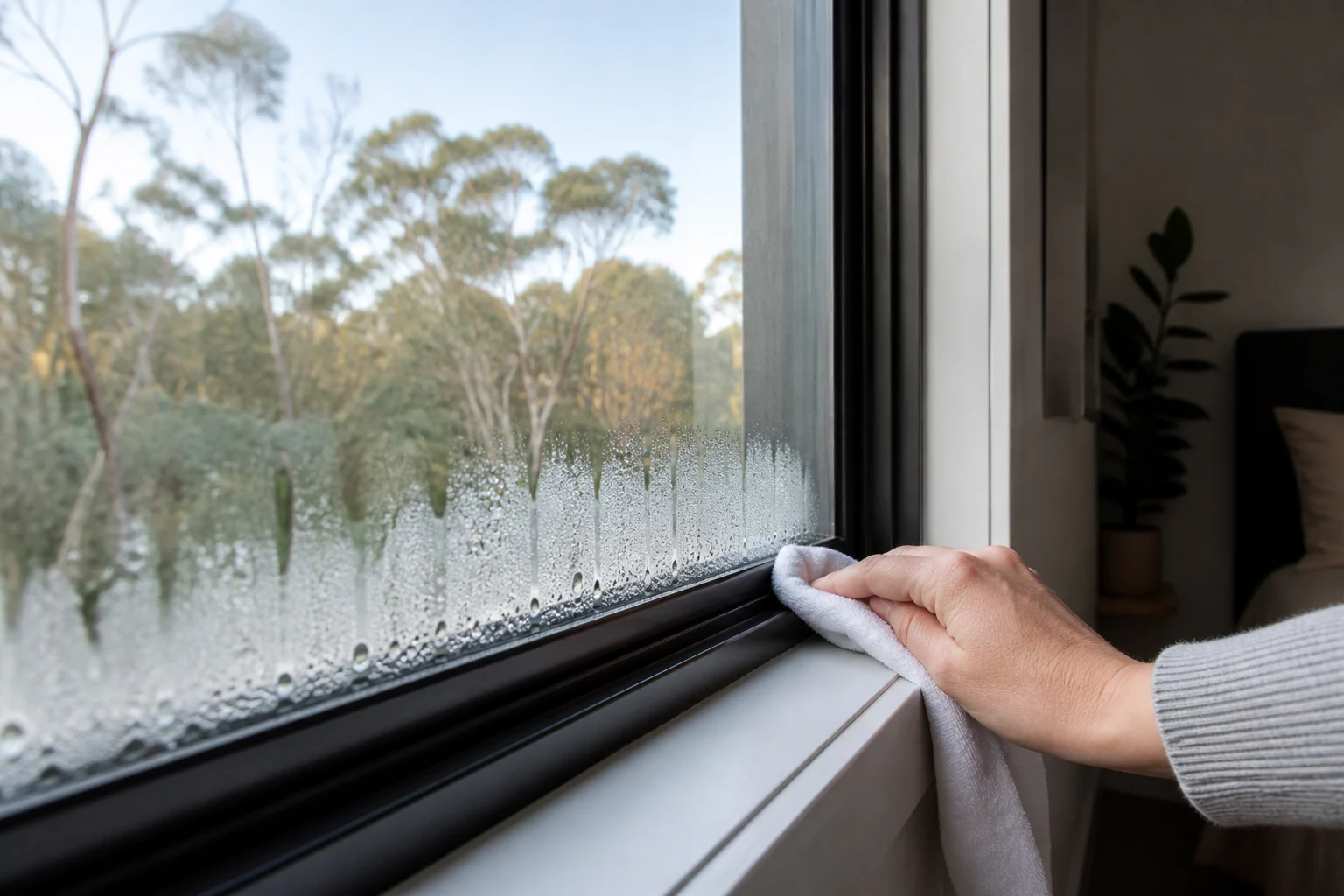
Window condensation forms when moist air meets a surface that is cold enough for water vapour to become liquid. In Australian homes, the location of the moisture is the fastest diagnostic clue: room-side condensation usually points to indoor humidity and a cold surface; outdoor condensation can be a normal sign of an efficient pane; moisture trapped between double-glazed panes usually indicates a failed insulated-glass seal.
Key takeaways
- First identify whether moisture is inside, outside or between the panes.
- Reduce indoor moisture at the source and use effective ventilation.
- Keep warm air moving across glass instead of trapping it behind closed coverings.
- Energy-efficient glazing and thermally improved frames keep internal surfaces warmer.
- Persistent inter-pane fogging normally needs professional assessment of the insulated glass unit.
Diagnose window condensation by location
| Where moisture appears | Likely mechanism | First response |
|---|---|---|
| On the room-side surface | Humid indoor air contacting cold glass or frame | Ventilate, control moisture sources, improve airflow and assess thermal performance |
| On the outdoor surface | Exterior glass has cooled below the outdoor dew point | Often temporary; confirm it clears as conditions change |
| Between double-glazed panes | Moisture has entered a nominally sealed cavity | Arrange professional inspection of the insulated glass unit |
| Around reveals or wall junctions | Possible thermal bridge, air leakage, water entry or construction moisture | Inspect seals, flashing, drainage and adjacent building fabric |
This diagnosis prevents a common mistake: treating every fogged window as a glazing failure. Room-side condensation can occur on a functioning window when indoor humidity is high enough. Conversely, moisture between panes cannot be removed by wiping the room-side glass because it sits inside the sealed unit.
Why windows condense in Australian homes
Warm air can hold more water vapour than cold air. When humid indoor air reaches a sufficiently cold window surface, the air at that boundary cools to its dew point and deposits water. The colder the internal pane or frame, and the higher the indoor humidity, the more likely condensation becomes.
Everyday activities add moisture: cooking, showers, unflued gas heaters, clothes drying and occupant breathing. New buildings can also release construction moisture from concrete, plaster and other wet trades. During cool nights, single glazing and conductive aluminium frames can present the coldest interior surfaces in the room.
The Australian Government’s Your Home glazing guide explains that efficient glazing keeps the inside surface closer to room temperature, reducing the conditions that produce condensation. It also notes that windows and frames must be considered together: a high-performance glass unit in a conductive frame can leave the frame edge comparatively cold.
A step-by-step condensation action plan
- Record the location and timing. Photograph whether moisture is room-side, outdoor or inter-pane. Note the room, outdoor conditions, time of day and activities occurring beforehand.
- Remove liquid water promptly. Dry the glass, frame, sill and adjacent finishes. Repeated wetting can damage finishes and support mould growth.
- Use source ventilation. Run bathroom and kitchen exhaust systems during moisture-producing activities and for the period recommended by the appliance or building professional. Confirm exhaust air is discharged outside, not into a roof space.
- Reduce avoidable moisture. Cover pots, vent clothes dryers outdoors where designed to do so, avoid drying laundry indoors when practical and follow safety guidance for heating appliances.
- Improve air movement. Do not trap damp air against cold glass behind tightly closed blinds for long periods. Maintain safe background ventilation appropriate to the building and climate.
- Check seals and drainage. Inspect weather seals, perimeter joints, flashing and drainage paths. Condensation, air leakage and rainwater entry can look similar but need different remedies.
- Measure before replacing. A simple temperature and relative-humidity logger can reveal when peaks occur. For recurring problems, engage a building professional to assess ventilation, insulation, thermal bridges and moisture sources.
What not to do
- Do not paint over mould or water staining without resolving the moisture source.
- Do not block required drainage holes or ventilation openings.
- Do not assume a dehumidifier corrects failed flashing, a leaking pipe or an inter-pane seal failure.
- Do not add aftermarket film to glass without checking thermal-stress compatibility and warranty conditions.
- Do not rely on a whole-house window replacement quote before identifying where the water is forming.
When energy-efficient windows can help
If repeated room-side condensation is associated with cold single glazing or conductive frames, a better-performing whole-window system can raise internal surface temperatures. Options may include double glazing, a suitable Low-E coating, warm-edge details, effective seals and thermally broken aluminium frames. The correct package depends on climate, orientation, opening size and the project’s energy requirements.
The Australian Government windows guide describes double glazing as two panes separated by a sealed gap that reduces heat transfer. For aluminium frames, it recommends a thermal break—an insulating barrier between internal and external profiles—to reduce conductive heat transfer.
Better glazing reduces condensation risk; it does not remove the need to manage indoor humidity and ventilation. Even a high-performance window can collect room-side moisture during an extreme humidity event. Equally, outdoor condensation can occur because an efficient system prevents indoor heat from warming the exterior pane.
Questions to ask a window supplier
- What are the whole-window Uw and SHGCw values for this exact configuration?
- Is the aluminium frame thermally broken, and how is the glass edge detailed?
- What glass build-up and spacer are proposed?
- How are operable sashes weather-sealed?
- What installation, perimeter-sealing and drainage details are required?
- What warranty applies to the insulated glass seal?
- Which project-specific structural, water, safety and energy documents are supplied?
Forge lists thermal-break aluminium systems compatible with double glazing and Low-E glass in its window and door range. A supplier discussion should still start with drawings, opening sizes, climate, orientation and required whole-window values rather than a generic request for “condensation-proof” windows.
Frequently asked questions
Why do my windows sweat on the inside in winter?
Room-side condensation usually occurs because humid indoor air is contacting cold glass or frame surfaces. Cooking, showers, clothes drying and some heaters increase indoor moisture. Source ventilation, moisture control, airflow and warmer internal window surfaces can all reduce the risk.
Is condensation between double-glazed panes normal?
No. Persistent moisture between the panes of an insulated glass unit usually indicates that the sealed cavity has been compromised. Because the moisture is inside the unit, room-side cleaning or ventilation will not remove it. Ask a qualified glazier or supplier to inspect the unit.
Can double glazing stop condensation completely?
Double glazing can keep the interior pane warmer and reduce room-side condensation risk, but it cannot guarantee zero condensation. Very high indoor humidity, poor ventilation, cold frame edges and extreme weather can still create moisture. Treat humidity control and window performance as one system.
Why is condensation appearing on the outside of new glass?
Outdoor condensation can occur when the exterior pane cools below the outdoor dew point and the efficient window prevents indoor heat from warming it. If it is temporary and clears as outdoor conditions change, it may indicate thermal separation rather than a defect.
When should I call a professional?
Seek professional help when water persists between panes, mould returns, reveals stay wet, finishes deteriorate, or the source is unclear. A building professional can distinguish indoor condensation from plumbing leaks, rainwater entry, failed seals, thermal bridges and inadequate ventilation.
Fix the cause, not just the water
Window condensation in Australia is best handled as a diagnosis: locate the moisture, control indoor sources, ventilate effectively, check seals and building junctions, then assess whether the whole-window system is cold enough to warrant an upgrade. If replacement is part of the solution, contact Forge Windows with photos, drawings and performance targets so the proposed configuration can be reviewed for the project.