
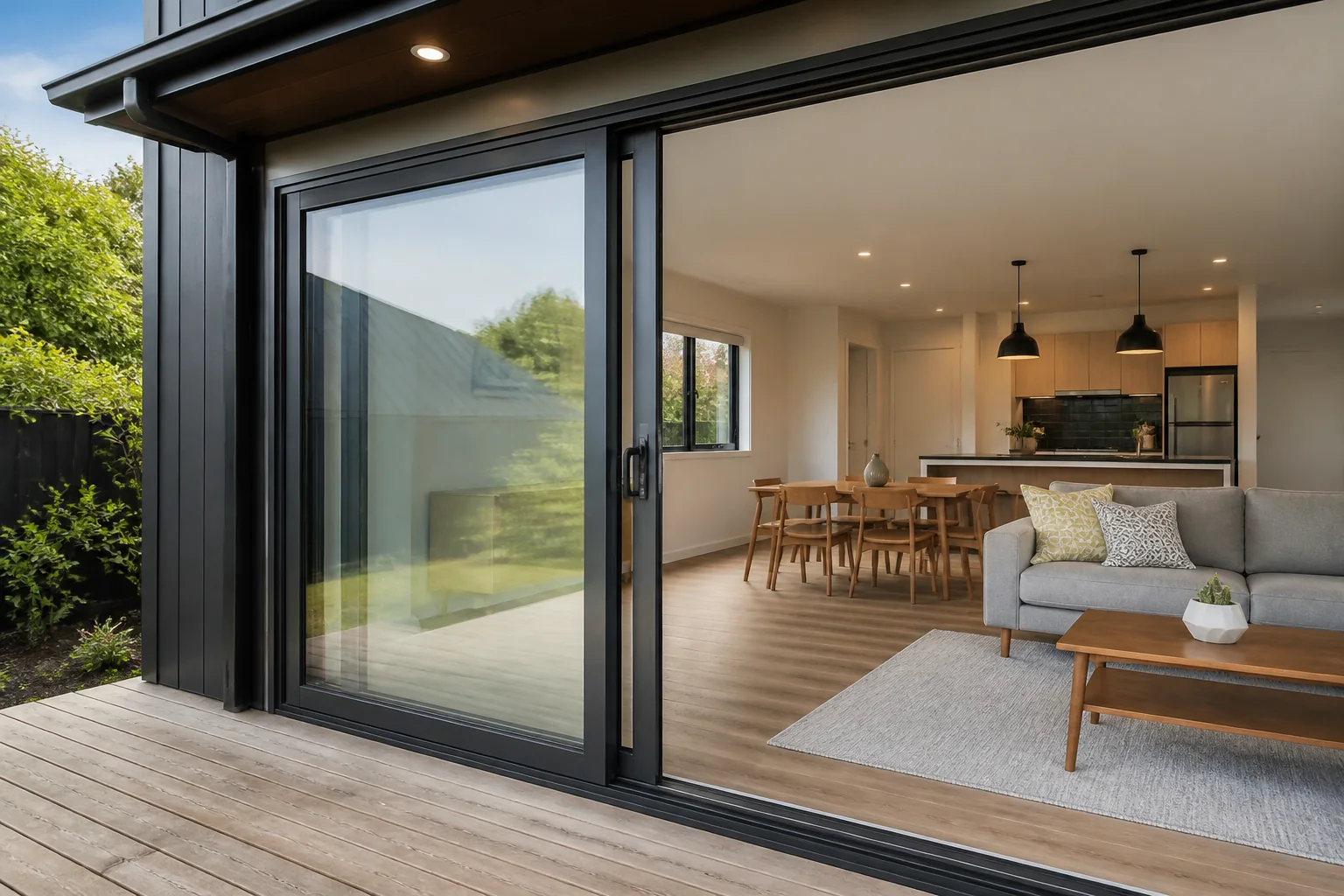
Ranchslider is associated with a New Zealand sliding-door product family from Altus Window Systems, while “ranch slider” is also used informally in New Zealand for a glazed patio slider. This independent article is not affiliated with or endorsed by Altus. Australian buyers should not assume that a New Zealand product name, brochure or compliance pathway proves suitability for an Australian project.
Key Takeaways
- Treat Ranchslider as a specific New Zealand product identity, not a generic Australian certification.
- Confirm the exact system, fabricator, configuration and country of supply.
- Request Australian project evidence for wind, water, glazing, energy and installation.
- Coordinate sill, drainage and floor levels before ordering.
- Use the product owner for current availability and technical claims.
What is a Ranchslider door?
Altus describes its Ranchslider doors as inside-sliding-panel doors in which a moving panel slides behind a fixed panel. The official page also describes configuration options. Those statements concern Altus products and should be checked against current technical literature and the specific fabricator.
The word can be used casually for similar sliding patio doors, but casual usage does not establish brand, components or performance. Ask for system identification rather than accepting a verbal label.
New Zealand and Australian evidence are different
New Zealand Building Performance guidance discusses “ranch slider” in the context of existing dwellings and New Zealand consent exemptions. That guidance belongs to the New Zealand regulatory system. It is not evidence of Australian NCC compliance.
For an Australian project, identify building class, wind design, exposure, glass, energy values, accessibility, drainage and installation pathway. Imported or locally fabricated products need documentation that applies to the actual assembly.
How to assess a Ranchslider or similar door
1. Confirm entity and product
Record the brand owner, system name, fabricator, series and drawing. Verify whether the quotation is for an authentic named system or merely uses “ranch slider” descriptively.
2. Define configuration
Show fixed and moving panels, sliding direction, meeting stiles, screens, locks and sill. Confirm clear opening and whether panels slide inside or outside. Forge’s fixed-plus-slider guide explains configuration terminology.
3. Request Australian evidence
For relevant housing work, the NCC installation provisions and glass provisions show why assembly installation and glass selection are separate checks. Confirm the current edition and state variations with the project team.
4. Coordinate threshold and water
Low-profile sill claims require a complete drainage and waterproofing detail. Do not cut a sill, block outlets or raise exterior finishes without documented approval. Verify the relationship between internal floor, track, membrane, balcony or deck and drainage.
5. Check supply and service
Confirm Australian availability, lead time, warranty provider, replacement rollers, locks, seals and glass. Do not rely on a New Zealand marketing page for local supply or support. Forge is independent and does not claim to manufacture, distribute or service Ranchslider products unless separately confirmed in writing.
Generic Australian alternatives
If the search intent is simply a sliding patio door, compare configurations without using the brand term. Forge’s sliding glass door buyer guide, hardware guide and glass-door guide cover relevant Australian questions.
Evidence checklist
- Brand, system, fabricator and series identified.
- Panel arrangement and sliding direction drawn.
- Australian wind and water evidence matches size.
- Glazing documentation matches location.
- Whole-door energy values match assessment.
- Sill and waterproofing detail coordinated.
- Screen, lock and access requirements specified.
- Installation instructions available.
- Local warranty and replacement parts confirmed.
- No NZ compliance statement presented as Australian evidence.
Frequently asked questions
Is Ranchslider a brand?
Altus presents Ranchslider as a named product family. The phrase is also used informally in New Zealand, so verify the exact entity and system.
Does Forge sell Ranchslider doors?
This article makes no such claim. Forge is independent of Altus; contact each company directly for current product availability.
Can a Ranchslider be used in Australia?
Potentially only if the proposed assembly and installation satisfy the Australian project’s requirements. New Zealand information alone is insufficient.
Is it the same as a sliding glass door?
It is a type or term associated with sliding patio doors, but configuration and components must be confirmed.
Does a flush sill guarantee accessibility?
No. Accessibility, drainage, floor levels and the complete route must be designed together.
Next step
For an Australian alternative, send the opening and performance brief to Forge Windows. For Ranchslider product claims, consult Altus directly.