
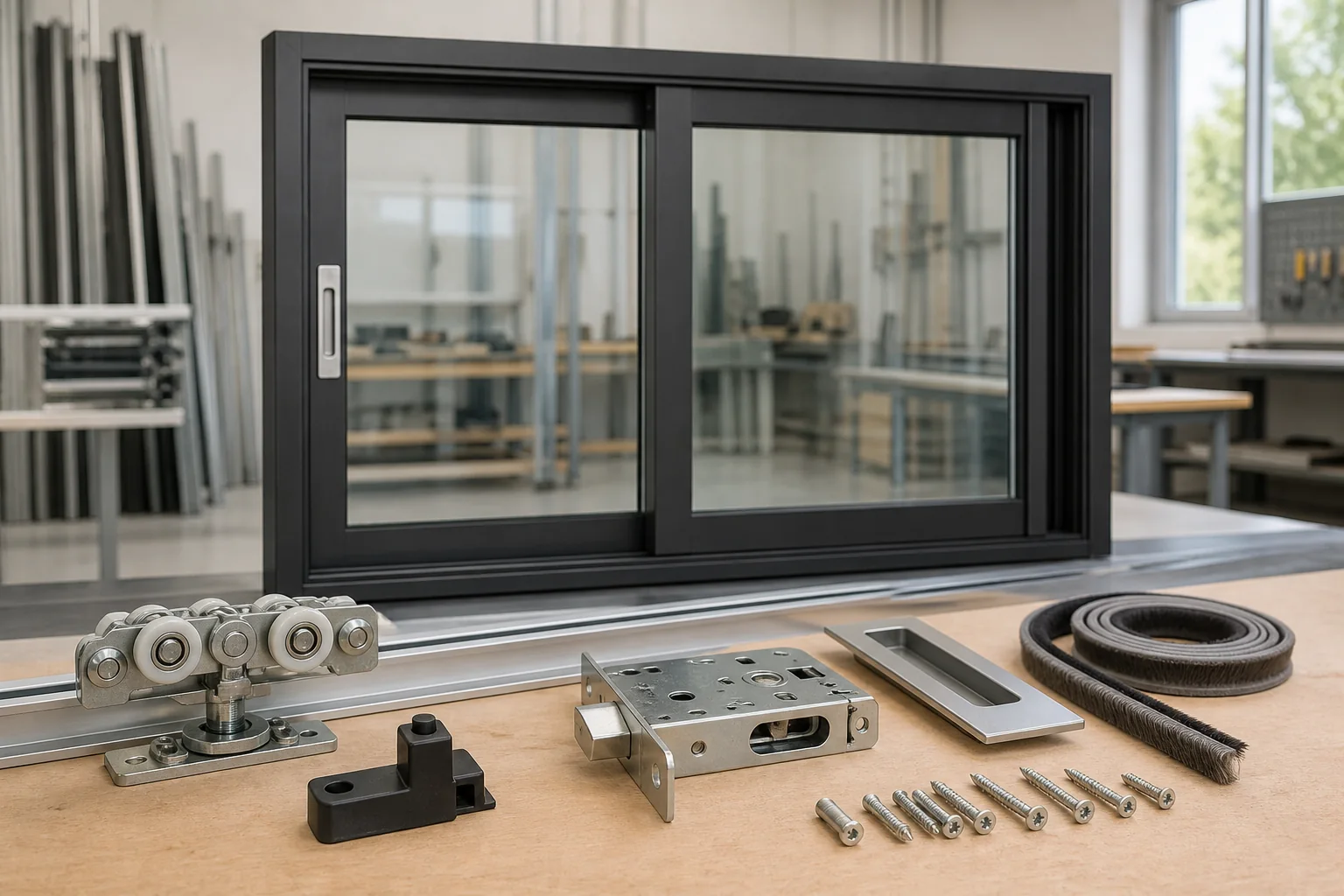
A sliding fitting is a hardware component—or coordinated hardware set—that supports, guides, operates, locks or seals a sliding door or window sash. Typical fittings include tracks, roller carriages, guides, stops, handles, locks, restrictors, fasteners and weather seals. Select them as a compatible system for the panel weight, frame geometry, environment and intended use, not as isolated parts that merely look similar.
Key takeaways
- “Sliding fitting” usually means hardware, but it can also describe the installation process; this guide covers both.
- Match every component to the exact frame, track, panel weight, movement and locking geometry.
- Door and window fittings are not interchangeable just because their wheel or handle dimensions appear close.
- Coastal exposure, safety, fall prevention, security and accessibility can change the required hardware.
- Diagnose the cause before replacing a roller, lock or track; one worn part may be the symptom rather than the fault.
What counts as a sliding fitting?
The Australian Glass and Window Association’s 2021 hardware industry code of practice covers locks, latches, stays, hinges, tracks, rollers, pivots, operators, winders, restrictors, fasteners, balances, handles, skids and retractable or pivoting seals for external residential windows and doors. This breadth shows why “fitting” should not be reduced to the visible handle.
| Fitting group | Main job | Compatibility questions |
|---|---|---|
| Track and sill | Provides the running surface and manages alignment | Profile shape, rail width, drainage and wear condition |
| Roller carriage | Carries panel load and allows adjustment | Wheel profile, capacity, fixing centres and adjustment range |
| Top or floor guide | Controls lateral movement and anti-lift behaviour | Clearance, panel groove, guide material and travel |
| Stops and buffers | Limits travel and absorbs closing energy | Panel mass, speed, fixing substrate and handle clearance |
| Lock and strike | Secures the closed panel | Backset, hook position, frame reinforcement and keying |
| Handle or pull | Provides controlled user grip | Hand clearance, accessibility, screw centres and panel overlap |
| Weather seal | Controls air, dust and water paths | Pile height, compression, drainage and replacement access |
| Restrictor | Limits opening where required | Window type, fixing, release, cleaning and project requirement |
How to select a sliding fitting system
- Identify the assembly. Record whether it is a horizontal sliding window, patio door, cavity door, barn door, wardrobe door, lift-and-slide unit or another system.
- Find the original product data. Use labels, invoices, profile drawings, hardware stamps and photographs. Ask the original supplier before assuming a generic replacement fits.
- Measure the moving panel. Record width, height, thickness, estimated or documented weight, travel direction and clearances.
- Document the track and fixing geometry. Measure wheel shape, rail width, carriage pocket, fixing centres, lock backset and strike position.
- Check duty and environment. Frequency, wind exposure, moisture, salt, industrial pollution and cleaning chemicals influence material and maintenance.
- Coordinate safety and access. Check pinch points, anti-lift provisions, restrictors, clear opening, handle reach and operating force.
- Verify the whole set. A new roller can raise the panel and misalign the lock; a thicker seal can increase drag; a new handle can collide with the fixed sash.
Doric’s current Australian hardware resources separate sliding-door hardware, window locks, rollers, restrictors, woven pile and other categories. The catalogue structure is a useful reminder to choose from technical data for the exact application rather than from a generic marketplace title.
Diagnose the fault before ordering replacement fittings
| Symptom | Possible causes | First checks |
|---|---|---|
| Heavy or jerky movement | Debris, worn rollers, damaged rail, misalignment, excessive seal friction | Clean track, inspect wheel and rail, test panel at several positions |
| Panel drops or rubs | Collapsed carriage, loose fixing, distorted sash or unsupported frame | Check corner heights, adjustment and frame square |
| Lock will not engage | Panel height changed, strike moved, hook worn, frame racked | Check panel alignment before adjusting the strike |
| Rattle or air leakage | Worn pile, incorrect roller height, missing guide, loose interlock | Inspect seals, overlap and guide clearance |
| Panel can lift | Missing anti-lift block, excessive head clearance, incorrect guide | Review original design and suitable anti-lift provision |
| Track repeatedly damages rollers | Pitted rail, point loading, wrong wheel profile or poor support | Assess track and panel load before fitting another roller |
Do not force a stuck glazed panel or drill near glass without understanding the frame. Large sashes may need specialist lifting equipment and more than one person. If the frame, sill or glass is damaged, treat the work as a window or door repair—not a simple hardware swap.
When “sliding fitting” means fitting the complete door or window
Installation coordinates the opening, sill support, flashings, fixings, frame alignment, drainage, glass, hardware and surrounding finishes. The Forge sliding glass door installation guide explains why a square-looking frame can still fail if the sill is unsupported or drainage paths are blocked.
The Australian Glass and Window Association’s residential installation guide includes care, fixing and aluminium sliding-door installation guidance. Use the current supplier instructions and project details with it; generic guidance cannot establish the fixing or flashing design for every wall.
Pre-installation checklist
- verify product, opening and finished-floor dimensions;
- confirm sill support, sub-sill, flashing and drainage design;
- keep frames square, level, plumb and free from twist;
- use approved fixing locations, types, spacing and packers;
- protect tracks, finishes, glass and hardware from building debris;
- commission rollers, locks, stops, seals and screens after installation;
- record cleaning and maintenance instructions at handover.
Maintenance and replacement boundaries
The AGWA installation guide recommends regular hardware maintenance, including six-month intervals in most environments and three-month intervals in marine and industrial environments. That is published general guidance; the product manufacturer may require a different schedule.
Use clean water and methods compatible with the finish. Keep tracks and sill drainage free of debris. Avoid oils or chemicals that attract dirt, damage polymers, wash into drainage paths or conflict with the manufacturer’s instructions. Replace defective fittings with documented compatible parts.
Coordinate sliding hardware with the complete system
For new work, start with the Forge door-system selection guide and the product overview. Send the project location, opening sizes, panel arrangement, glass, expected use, hardware and performance targets through the contact page. Forge must confirm available hardware and project suitability.
Sources and evidence boundary
This is an educational selection and maintenance guide, not a hardware schedule or installation instruction for a specific product. Load ratings, corrosion resistance, safety functions and fixing details require current manufacturer data and project assessment.
Frequently asked questions
What does sliding fitting mean?
It usually means the hardware that lets a panel slide, guide, stop, lock and seal, such as tracks, rollers, guides, handles and locks. In some searches it also means the work of installing a sliding door or window.
Can I replace a sliding-door roller with the same-size wheel?
Wheel diameter alone is insufficient. Match wheel profile, carriage dimensions, fixing centres, adjustment range, load capacity, track material and panel design. An incorrect carriage can change panel height, lock alignment and safety clearances.
Why is my sliding door still hard to move after new rollers?
The track may be damaged, the frame twisted, the sash overloaded or seals too tight. Check the complete travel and alignment. Replacing one component will not correct an unsupported sill or distorted frame.
How often should sliding fittings be maintained?
AGWA’s general residential guide recommends hardware maintenance every six months in most environments and every three months in marine and industrial environments. Follow the exact manufacturer’s current instructions if they differ.
Are window and door sliding fittings interchangeable?
Usually not. Door panels are generally larger and heavier, while window systems have different tracks, locks, restrictors and drainage. Use product-specific data and do not transfer a fitting solely because it appears to fit.