
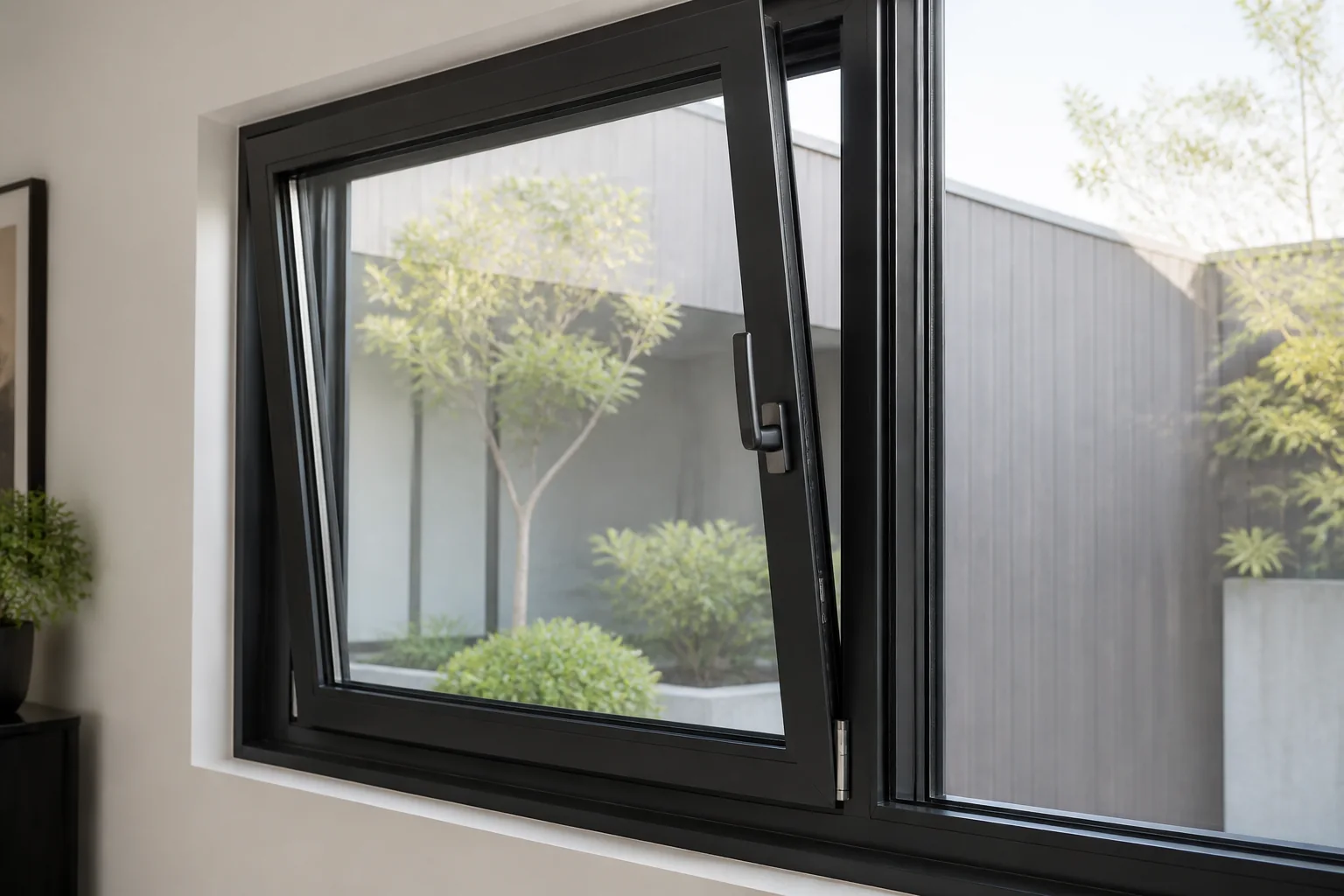
An aluminium Domal window should be treated as a named window-system enquiry, not a generic promise of quality. Domal’s official Italian site presents aluminium window, sliding, door and façade systems, while some unrelated marketplace listings use “Domal profile” more loosely. For an Australian project, verify the exact brand, series, fabricator, test configuration, local support and project-specific evidence before comparing it with locally available systems.
Key takeaways
- Confirm whether “Domal” means an official current Domal system or a generic regional profile description.
- European classifications and product claims are not automatically evidence for Australian requirements.
- Compare the whole fabricated window—frame, glass, hardware, seals and installation—not the extrusion name alone.
- Check Australian availability, authorised fabrication, spare parts, warranty and replacement glass support.
- Forge has no stated affiliation with Domal and does not claim to supply the brand unless confirmed in writing.
What is an aluminium Domal window?
Domal is a third-party aluminium building-systems brand. Its official product overview groups systems for windows and French windows, sliding openings, doors and curtain walls. Individual series have specific profiles, applications, hardware options and declared performance.
Search results also show sellers—especially in parts of South Asia—using “Domal window” or “Domal profile” as a broad product description. A listing may therefore refer to an official branded system, a locally fabricated derivative, or an unrelated generic profile. The words alone cannot identify the aluminium alloy, wall thickness, thermal break, glass, hardware or test evidence.
Verify the product before reviewing performance
- Ask for the full system name and series. Record frame depth, sash type, opening mode and document revision.
- Confirm the profile source. Request labels, extrusion markings, invoices or an authorised supply-chain statement.
- Identify the fabricator. Window performance depends on cutting, drainage, corner assembly, seals, hardware, glazing and quality control.
- Match the tested specimen. Check size, number of sashes, opening type, glass, seals, hardware and installation conditions.
- Confirm Australian supply and service. Ask who provides technical support, replacements, warranty response and spare fittings.
- Check the final project schedule. A profile brochure is not an approved shop drawing for the fabricated window.
| Description encountered | What it may mean | Evidence to request |
|---|---|---|
| Official Domal series | Named system shown in current Domal documentation | Series data, fabricator status, exact test reports and project drawings |
| “Domal profile” | Regional trade term or generic aluminium section | Actual manufacturer, extrusion drawing, alloy, finish and testing |
| Domal-style window | Visual or configuration comparison only | Complete identity; do not assume common parts or performance |
| Imported finished window | Factory-fabricated unit shipped to Australia | Australian project evidence, glass, logistics, installation and warranty plan |
How to compare an aluminium Domal window for Australia
Opening type and everyday use
Confirm whether the project needs sliding, casement, awning, tilt-and-turn, fixed or a combined unit. The official Domal range includes several opening types, but availability depends on series and fabricator. Consider clear opening, screens, cleaning, handle reach, ventilation and interference with curtains or external paths.
Frame and thermal design
Ask whether the exact frame is conventional aluminium or thermally broken, then compare whole-window performance. Domal’s official TOP TB page publishes European product claims and test classifications for stated configurations. Those values illustrate the importance of series and specimen details; they should not be copied into an Australian schedule without evidence that applies to the proposed window.
Glass and hardware
Specify glass for structural load, human impact, thermal performance, acoustics, safety and any bushfire or barrier function. Confirm hinges, rollers, multipoint locks, restrictors, handles, gaskets and replacement-part availability. A high-performance frame can be undermined by incompatible glazing or poorly selected fittings.
Finish and environment
Record powder-coat or anodised finish, colour, gloss, coastal exposure, cleaning and maintenance. Ask how cut edges, fasteners and dissimilar metals are managed. A European finish reference may not address the exact Australian coastal or industrial environment.
Translate product data into Australian project evidence
The Australian Building Codes Board’s NCC Housing Provisions Section 8 addresses windows, external glazed doors, glass and human-impact glazing for relevant Class 1 and 10 buildings. The responsible designer and certifier must identify the current National Construction Code, referenced standards and state or territory variations.
The Australian Government’s YourHome glazing guide explains whole-window U-value and solar heat gain coefficient. Compare ratings for the exact frame-and-glass combination proposed. Do not substitute a centre-of-glass value, a European classification or a value from a different size and opening type.
Evidence checklist
- structural and water-penetration evidence for the proposed type and size;
- air-infiltration data where required;
- whole-window U-value and SHGC for the exact configuration;
- glass selection, markings and human-impact requirements;
- hardware capacities and restrictor or safety functions;
- finish suitability and corrosion-resistance information;
- installation, sub-sill, flashing, drainage and fixing details;
- English project documents with traceable report numbers and revisions.
The Forge WERS guide and Low-E versus double-glazing guide provide Australian context for comparing frame-and-glass options.
Procurement and import checks
Before ordering an overseas or unfamiliar system, confirm currency, tax, freight basis, packaging, unloading, storage, transit damage, replacement lead times and responsibility for final site dimensions. Determine who will install the windows and whether they have the required system instructions, tooling and support.
Ask how warranty work would be handled in Australia. A long written warranty is less useful if the local fabricator, seals, hardware, glass or replacement profiles cannot be accessed. Record acceptable substitutions before manufacture, not after a container arrives.
Compare with verified local project options
Use the aluminium sliding window guide and Forge product overview to define the required opening and performance, then compare proposals on the same schedule. Submit project location, drawings, dimensions, quantities, opening type, glass, finish, performance targets and programme through the contact page. Forge must confirm available systems; it should not be assumed to supply Domal.
Sources and evidence boundary
This independent article discusses Domal because it appears in the target keyword. No canonical Forge or Domal entity profile was available in the project memory, so brand resolution remains a documented concern. Official Domal pages are Italian-market sources; current Australian availability, authorised fabrication and project compliance were not established and require direct verification.
Frequently asked questions
Is every aluminium Domal window made by Domal?
No. Some listings use “Domal” or “Domal profile” loosely. Ask for the exact brand, series, profile source, fabricator and documentation. Do not infer identity from the listing title or window appearance.
Are Domal European performance values valid in Australia?
They may describe a specific European test specimen, but they are not automatically Australian project evidence. Have the responsible professionals assess the report, configuration, standards, dimensions and installation against current local requirements.
Does Forge supply Domal windows?
That should not be assumed. Forge has no stated affiliation with Domal in the available project information. Contact Forge with the project schedule to confirm which systems and configurations can actually be supplied.
What should I compare instead of profile brand alone?
Compare opening type, exact frame series, fabricated quality, glass, hardware, seals, whole-window thermal data, structural and water evidence, finish, installation, local support, warranty and replacement-part availability.
Can I import a Domal window directly?
Import may be possible, but first resolve Australian project evidence, glass, final dimensions, freight, damage risk, installation instructions, local labour, warranty response and spare parts. A product brochure does not resolve those responsibilities.