
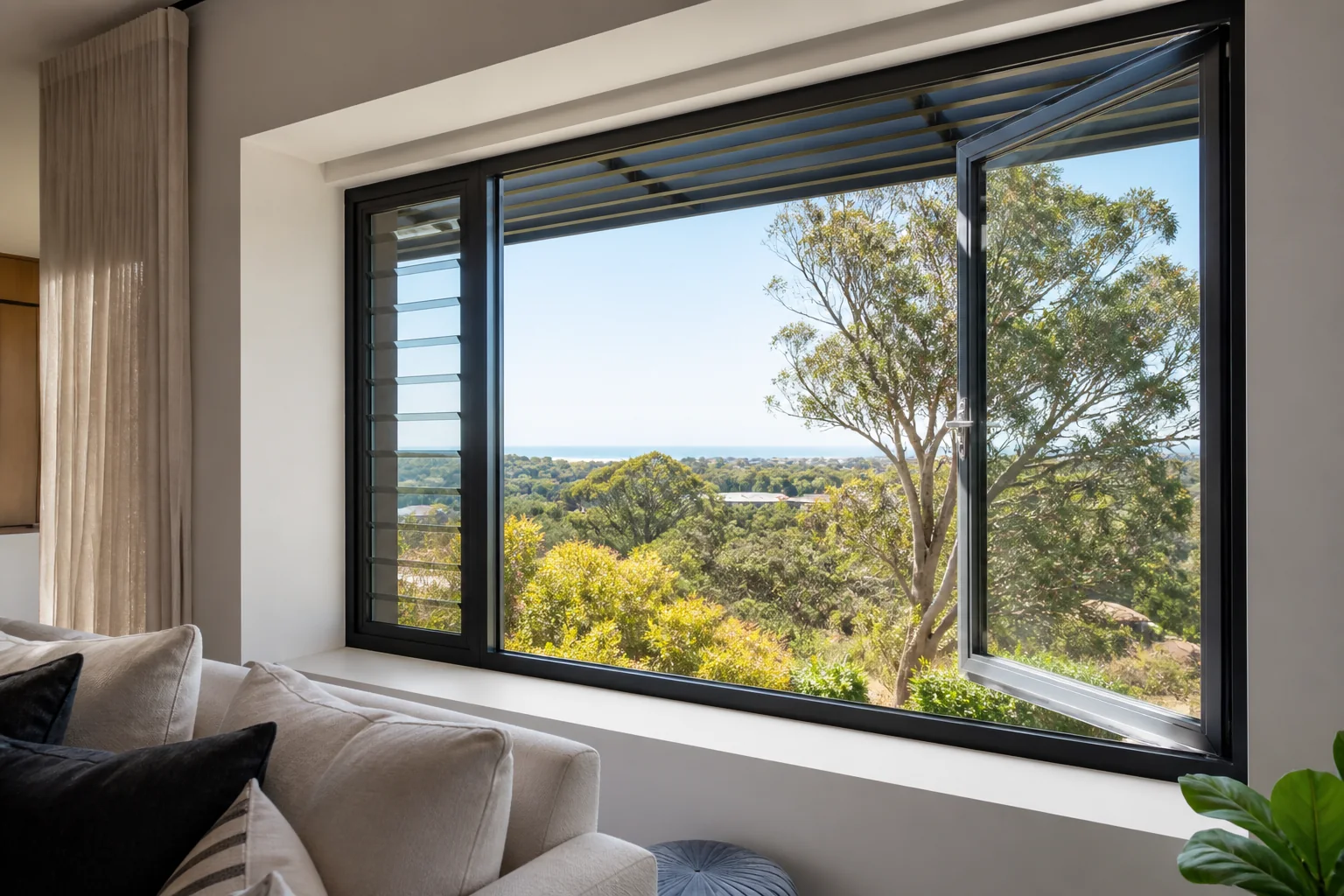
Energy efficient casement windows combine a side-hinged sash with a complete frame, glazing, seals and hardware selected for the building’s climate, orientation and energy assessment. Casements can close against compression seals, but the opening style alone does not prove efficiency. Compare verified whole-window U-Value and Solar Heat Gain Coefficient (SHGC), air leakage, size, installation and shading for the exact product.
Key Takeaways
- Use whole-window values, not centre-of-glass claims.
- Match SHGC, U-Value and shading to orientation and climate.
- Check seals, locking points and installation because gaps can undermine performance.
- Choose glazing, frame and spacer as one system.
- Retain rating and product evidence for the installed configuration.
What makes a casement window energy efficient?
Efficiency is the result of heat flow, solar gain, air leakage and installation. U-Value describes heat transfer through the complete window; lower values generally indicate less heat transfer. SHGC describes how much solar heat enters through the assembly. A lower SHGC is not automatically better: useful winter sun and unwanted summer heat depend on climate, orientation and shading.
The NCC external glazing provisions use Total System U-Values and Total System SHGCs for covered housing solutions. These combine glass and frame. The project energy assessor should nominate the required values and permitted substitutions.
Energy-related options compared
| Feature | Potential role | Evidence needed |
|---|---|---|
| Double glazing | Insulating air or gas space between panes | Whole-window rating for selected build-up |
| Low-E coating | Changes radiant heat transfer and solar properties | Coating surface and rated system values |
| Insulated frame/profile | Reduces frame heat flow | Complete frame-and-glass result |
| Compression seals | Controls air paths when sash is locked | Product design, adjustment and maintenance |
| External shading | Manages direct sun before it reaches glass | Orientation-specific building design |
How to choose energy efficient casement windows
1. Start with the energy model
Record climate zone, orientation, window area, shading and room use. Avoid selecting the same glass for every façade without assessment. The Australian Government’s Your Home glazing guidance explains how glazing, orientation and shading interact in passive design.
2. Compare complete-window ratings
Ask for a rating that represents the proposed size and configuration. Forge’s WERS guide explains how to interpret window ratings, while the Low-E versus double glazing guide distinguishes two commonly confused choices.
3. Check ventilation and operation
Casements can provide a large clear opening, but open windows do not save energy in every condition. Define when natural ventilation is beneficial and how the window is safely controlled. Confirm restrictors, screens and handles do not prevent intended use.
4. Specify installation
The ABCB installation provisions state principles for covered housing situations, including avoiding structural load transfer and maintaining frame geometry. A twisted frame can create uneven seals. Follow the manufacturer and approved wall detail.
5. Commission and maintain
Lock each sash and inspect continuous seal contact. Check hardware adjustment, drainage and perimeter sealing. Keep rating labels and invoices. Replace worn seals with compatible parts rather than generic materials that interfere with drainage or locking.
Specification checklist
- Energy assessor’s U-Value and SHGC requirements recorded.
- Orientation and shading shown.
- Whole-window evidence matches configuration.
- Glass build-up and Low-E surface identified.
- Frame, spacer, seals and hardware included in comparison.
- Ventilation and restrictor needs documented.
- Installation and flashing detail approved.
- Sash swing clears exterior obstacles.
- Operation and seal contact tested.
- Ratings and maintenance documents retained.
For installation detail, see Forge’s casement installation guide and condensation guide.
Frequently asked questions
Are casement windows more efficient than sliding windows?
They can achieve effective compression sealing, but actual performance depends on the rated product, size, glass, frame, seals and installation. Compare verified whole-window values.
Is double glazing always required?
Requirements depend on the energy solution, climate, design and whole-window values. Do not assume one glass type is mandatory for every project.
What U-Value should I choose?
Use the value required by the project energy assessment. Lower usually means less heat transfer, but SHGC and orientation also matter.
Does Low-E glass make a casement efficient?
It can improve a selected system, but the coating, glass build-up, frame and spacer must be assessed together.
Can old casements be improved?
Air-seal repairs, hardware adjustment, shading or secondary measures may help, but suitability depends on frame condition and project goals.
Next step
Send the energy-assessment targets and window schedule to Forge Windows for a configuration discussion.